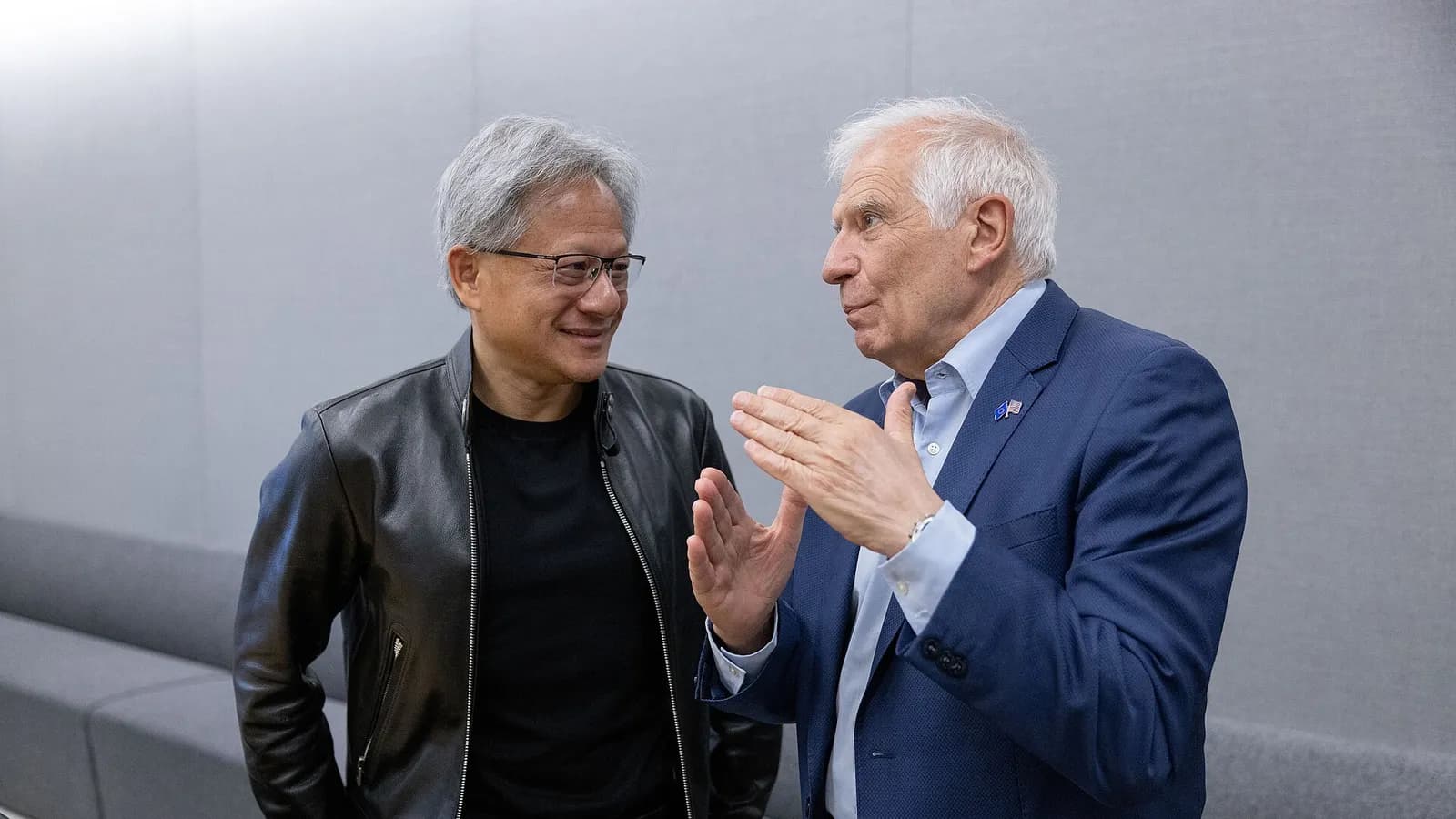
Jensen Huang resigns as Nvidia CEO after more than 33 years at the helm of a company he cofounded in 1993. The news has rattled markets and AI-industry watchers alike. Nvidia's board accepted his resignation effective immediately. The decision followed an internal investigation into two extramarital affairs, one of which involved a woman US authorities believe was connected to Chinese intelligence efforts. Shares fell as much as 13 percent in early trading on November 12, 2026, before recovering slightly, erasing a reported $400 billion or more in market value in a single move.
For business leaders who do not follow chip-industry gossip, the instinct might be to treat this as a tabloid story. That instinct is wrong. Nvidia sits at the center of the infrastructure that trains and runs the AI systems companies now build on, including OpenAI's ChatGPT and Anthropic's Claude. A leadership shock at that scale is worth five minutes of attention from anyone whose roadmap depends on GPU availability, AI vendor stability or the broader direction of US-China trade policy.
What happened when Jensen Huang resigned as Nvidia CEO
According to reporting from Ars Technica (citing the Financial Times) and Wired, the sequence ran roughly as follows:
- The New York Times reported that Huang had been the target of a Chinese intelligence operation. The operation was carried out through a relationship with a woman known as Alice Huang, who held a senior position at a Singapore-based AI company called Megaspeed.
- Nvidia's board announced an internal investigation on November 8.
- On November 11, further reporting surfaced that Huang had a separate relationship with a direct report inside Nvidia.
- Huang sent a companywide email acknowledging the affair and apologizing to his family and employees.
- The board accepted his resignation days later, naming CFO Colette Kress as interim CEO while it searches for a permanent replacement.
Wired's reporting adds a detail that matters for anyone trying to understand the board's motivation. A source close to the matter suggested the relationship with a subordinate, plus Huang's business ties to Megaspeed, likely weighed more heavily on the board's decision than the espionage allegations themselves. That nuance signals a governance failure around conflicts of interest, not only a personal scandal.
Why Nvidia's market position matters beyond one resignation
Nvidia controlled approximately 90 percent of the desktop discrete GPU, or add-in board, market as of 2026. Its share of the AI accelerator market, a related but distinct category, is estimated at 75 to 80 percent. Combined with its CUDA software ecosystem, that concentration still makes Nvidia close to a single point of failure for AI infrastructure worldwide. A sudden change at the top of a company with that kind of market position touches several areas at once.
| Area | What to watch |
|---|---|
| Procurement planning | Expect short-term uncertainty in Nvidia's external communications and account management |
| Trade policy exposure | A new CEO may take a more cautious public stance on export controls than Huang did |
| Investor sentiment | A sharp single-day drop ripples into valuations across the AI infrastructure sector |
Huang had been a vocal critic of US export controls on chips to China. He had cultivated a relationship with the US administration to advocate for looser rules. A new, less established CEO may be more cautious publicly, which could shift how quickly any China-related chip policy evolves.
None of this means AI projects should stop. It does mean that any company treating a single hardware supplier as a fixed, risk-free constant should revisit that assumption.
What business leaders should check after Jensen Huang's Nvidia resignation
We work with companies that depend on AI tooling, cloud infrastructure and ERP systems that increasingly include AI features. We think about vendor risk the same way we think about AI & ML development work generally: assume no single vendor relationship is permanent.
- Review contract terms with AI and cloud vendors. Check for clauses on pricing changes, service continuity and what happens if a supplier undergoes leadership or ownership change.
- Map your GPU and AI dependency. List which of your products or internal tools rely directly or indirectly on Nvidia hardware, whether through your own infrastructure or through a provider like OpenAI or Anthropic.
- Avoid single-vendor lock-in where practical. This is harder for GPU-heavy workloads than for software. Even partial diversification, such as testing workloads on a second cloud provider, reduces exposure.
- Separate personal-conduct risk from business-continuity risk. The governance failure here is a reminder to audit your own conflict-of-interest policies, not just Nvidia's.
- Watch, don't panic. A CEO resignation at a major supplier is a signal to monitor. Interim CEO Colette Kress is an internal finance executive, which generally points toward continuity rather than an abrupt strategic reversal.
A trade-off worth naming
Diversifying away from a dominant chip supplier sounds sensible on paper. In practice it carries real costs: retraining engineering teams on different hardware, rewriting optimized code away from CUDA, and often accepting lower raw performance per dollar in the short term. Full diversification is not realistic within a single budget cycle for most companies. The more practical move is to document the dependency, price out one or two fallback options, and revisit the decision at the next planning cycle rather than treating single-vendor reliance as permanent.
How this connects to systems you already run
Many companies run operations on an ERP like Odoo and are starting to layer in AI-assisted features for demand forecasting, support automation or reporting. This story is a useful prompt to ask your implementation partner how portable those AI integrations are. A system built with API integration services that assume a single AI provider is harder to adjust than one built with abstraction layers that can swap providers. We also cover related governance and leadership-risk angles in our AI category, including an earlier piece on Nvidia's own espionage investigation that is worth reading alongside this update.
Boards everywhere should take one lesson from the Jensen Huang Nvidia CEO resignation regardless of industry. Conflict-of-interest disclosure policies are not paperwork. They are the mechanism that catches exactly this kind of overlap between personal relationships and business dealings before it becomes a market event.